What Is DeFi?
Decentralized Finance (DeFi) represents a revolutionary approach to financial services that operates without traditional intermediaries like banks, brokers, or insurance companies. Built on blockchain technology, DeFi protocols enable peer-to-peer financial transactions through smart contracts—self-executing agreements with terms directly written into code.
The DeFi ecosystem has grown exponentially since its inception, with total value locked (TVL) exceeding $50 billion across various protocols. This represents a fundamental shift from centralized financial systems to open, permissionless, and transparent financial services accessible to anyone with an internet connection.
Unlike traditional finance where institutions control your money and transactions, DeFi puts users in complete control of their assets. You maintain custody of your funds through private keys while accessing services like lending, borrowing, trading, and yield farming directly from your digital wallet.
How DeFi Works
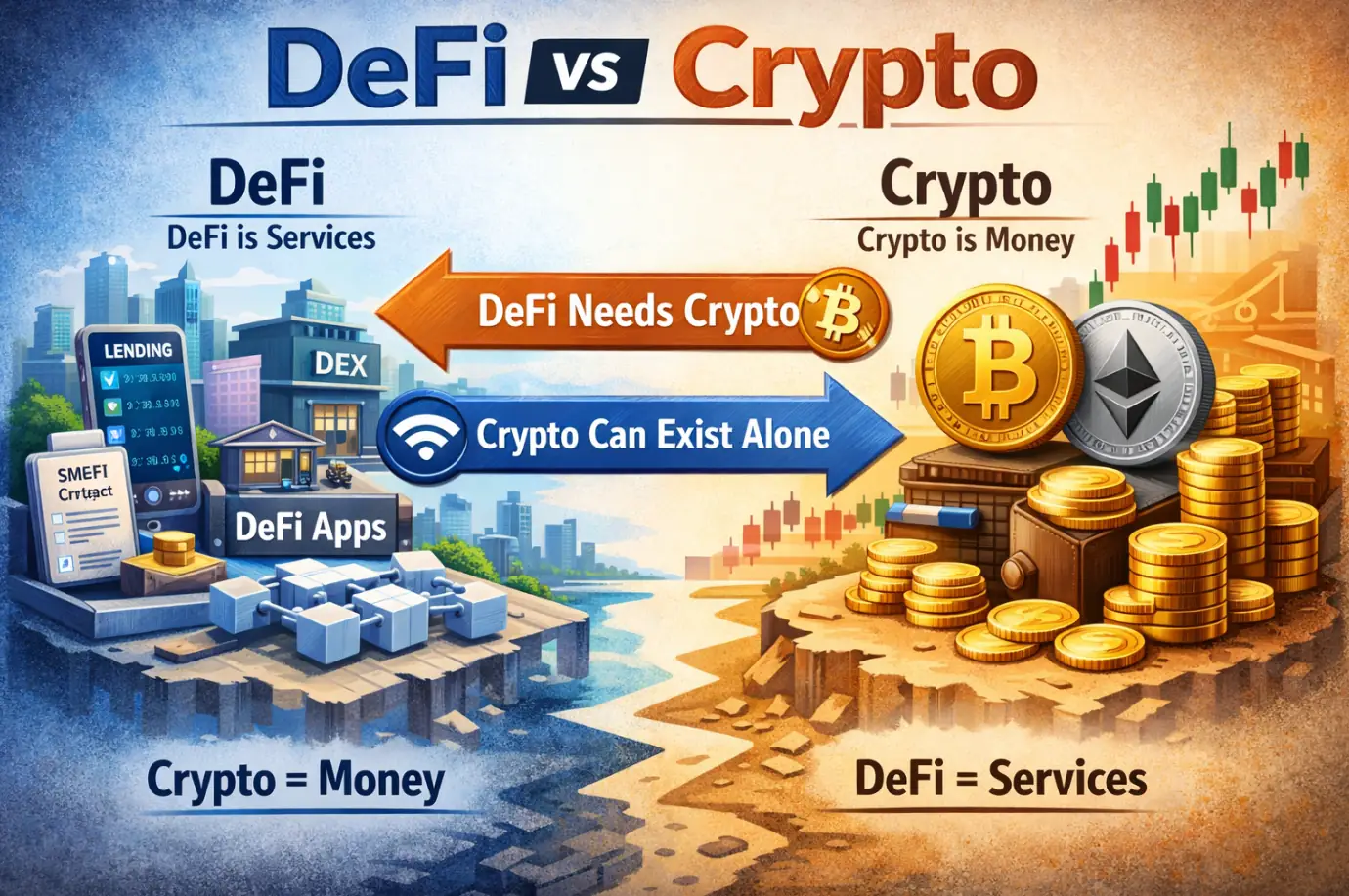
DeFi operates on blockchain networks, primarily Ethereum, through smart contracts that automatically execute financial agreements. These contracts eliminate the need for trusted third parties by making terms transparent and execution guaranteed by code.
Smart contracts are immutable programs that run exactly as programmed without downtime, censorship, fraud, or third-party interference. When you interact with a DeFi protocol, you're directly communicating with these smart contracts through your cryptocurrency wallet.
The process typically involves:
- Connecting Your Wallet: You connect a compatible wallet (MetaMask, Trust Wallet, etc.) to the DeFi platform
- Approving Transactions: Smart contracts require your approval to access your funds for specific actions
- Executing Functions: The contract automatically performs the agreed-upon financial service
- Receiving Results: Funds, interest, or other outcomes are distributed according to the contract terms
This trustless system operates 24/7 without geographical restrictions, bank holidays, or traditional business hours. The transparency of blockchain ensures all transactions are publicly verifiable while maintaining user pseudonymity.
Key DeFi Protocols
The DeFi ecosystem comprises several categories of protocols, each serving different financial functions:
Lending and Borrowing Protocols
Platforms like Aave, Compound, and MakerDAO allow users to lend their crypto assets to earn interest or borrow against collateral. These protocols use over-collateralization to ensure loan repayment while offering competitive interest rates often superior to traditional banking.
For example, you can deposit Ethereum as collateral and borrow stablecoins like DAI at variable interest rates, all without credit checks or lengthy approval processes.

Decentralized Exchanges (DEXs)
Uniswap, SushiSwap, and PancakeSwap are automated market makers (AMMs) that enable peer-to-peer trading without order books. Users provide liquidity to trading pairs and earn fees from traders while maintaining control of their assets.
These platforms have processed over $1 trillion in trading volume, demonstrating the growing preference for decentralized trading alternatives to centralized exchanges.
Yield Farming and Liquidity Mining
Users can earn additional rewards by providing liquidity to DeFi protocols. This involves depositing paired assets (like ETH/USDT) into liquidity pools and receiving LP tokens representing their share, plus trading fees and bonus tokens.
While potentially lucrative, yield farming requires understanding impermanent loss and smart contract risks. Many platforms now offer simplified single-asset staking options for beginners.
Stablecoins
Stablecoins like DAI, USDC, and USDT provide price stability in the volatile crypto market. DAI is algorithmically stabilized through over-collateralization, while USDC is backed 1:1 with USD reserves. These tokens facilitate trading, lending, and everyday transactions within DeFi.
DeFi Use Cases
DeFi applications extend far beyond simple trading and lending:
Synthetics and Derivatives
Protocols like Synthetix allow users to trade synthetic assets that track real-world prices—stocks, commodities, or indices—without owning the underlying asset. This creates global access to traditional financial instruments through blockchain technology.
Insurance
DeFi insurance protocols like Nexus Mutual protect users against smart contract failures, exchange hacks, and other risks. Users pool funds to provide coverage and earn premiums while maintaining decentralized governance.
Decentralized Autonomous Organizations (DAOs)
DAOs use DeFi principles for governance, allowing token holders to vote on protocol changes, treasury allocations, and strategic decisions. This creates truly community-owned financial infrastructure.

Cross-Chain Bridges
As DeFi expands beyond Ethereum to networks like Solana, Avalanche, and Polygon, cross-chain bridges enable seamless asset transfers between different blockchains, increasing accessibility and reducing transaction costs.
Benefits and Risks of DeFi
Key Benefits
- Permissionless Access: No KYC requirements or geographic restrictions
- Higher Returns: Often better interest rates than traditional banking
- Transparency: All transactions are publicly verifiable on-chain
- Composability: Protocols can be combined like financial building blocks
- 24/7 Availability: No banking hours or maintenance downtime
- User Control: You maintain custody of your funds at all times
Primary Risks
- Smart Contract Risk: Bugs or vulnerabilities can lead to fund loss
- Impermanent Loss: Liquidity providers may lose value during price volatility
- Volatility Risk: Crypto asset prices can fluctuate dramatically
- Regulatory Uncertainty: Evolving regulations may impact DeFi operations
- Liquidity Risk: Difficulty exiting positions during market stress
Getting Started with DeFi
Entering the DeFi space requires careful preparation:
1. Secure Your Wallet
Start with a non-custodial wallet like MetaMask, Trust Wallet, or Ledger hardware wallet. Never share your private keys or recovery phrases with anyone. Enable two-factor authentication and consider using a hardware wallet for significant holdings.
2. Start Small
Begin with small amounts to familiarize yourself with different protocols. Learn how transactions work, gas fees, and contract interactions before committing larger funds. Consider using testnets to practice without risk.
3. Research Thoroughly
Check protocol audits, team backgrounds, and community feedback. Look for established protocols with significant TVL and regular security audits. Understand the specific risks of each platform before participating.

4. Diversify Risk
Don't put all funds in one protocol or token. Spread investments across different platforms and asset types. Consider stablecoins for portions you want to preserve while earning yield.
5. Stay Informed
Follow reputable DeFi news sources, community forums, and protocol updates. The space evolves rapidly, and staying informed helps identify opportunities and potential risks early.
Recommended Beginner-Friendly Protocols
- Compound: Simple lending and borrowing with clear UI
- MakerDAO: Generate DAI stablecoin through collateral deposits
- Yearn Finance: Automated yield optimization across protocols
- Curve Finance: Low-slippage stablecoin trading
- Convex Finance: Simplified Curve liquidity mining
Frequently Asked Questions
Is DeFi safe to use?
DeFi offers both opportunities and risks. Established protocols with strong security measures are generally safe for experienced users, but the space requires technical knowledge and risk awareness. Never invest more than you can afford to lose.
How much money do I need to start?
You can start with as little as $10-50 to experiment with basic DeFi functions. However, consider gas fees (network transaction costs) which can be significant on Ethereum during high-traffic periods. Many users start with $100-500 for meaningful participation.
Do I need technical knowledge?
Basic DeFi participation requires understanding wallet management, gas fees, and smart contract interactions. Many user-friendly interfaces have simplified the process, but technical literacy helps identify risks and troubleshoot issues.
Can I lose all my money?
Yes, significant losses are possible through smart contract failures, impermanent loss, market volatility, or user errors. Proper risk management, diversification, and starting with small amounts can help protect your capital.
What's the difference between DeFi and traditional finance?
DeFi operates without intermediaries, provides global access, offers higher potential returns, but with increased risks. Traditional finance has regulatory protections, established systems, but lower yields and access barriers. Each has distinct advantages and drawbacks.
Are DeFi returns taxable?
Yes, DeFi earnings are typically taxable as capital gains or ordinary income depending on your jurisdiction. Interest, rewards, and trading profits require proper record-keeping. Consult tax professionals familiar with cryptocurrency regulations in your area.
Conclusion
DeFi represents a fundamental reimagining of financial services, offering unprecedented access, transparency, and potential returns. However, this innovation comes with significant complexity and risk that requires careful consideration and education.
The key to successful DeFi participation is gradual learning, risk management, and staying informed about the rapidly evolving ecosystem. As the technology matures and user interfaces improve, DeFi will likely become more accessible to mainstream users.
Whether you're exploring yield farming, decentralized lending, or building on Web3, understanding the foundational principles outlined in this guide will serve you well. Remember that in DeFi, you have complete control and responsibility for your assets—the freedom and the risk come together.
For ongoing learning, explore our comprehensive guides on DeFi security best practices, understand how smart contracts power DeFi applications, and stay updated with the latest DeFi news and developments. The future of decentralized finance is being built today, and informed participants will be best positioned to navigate its opportunities. Readers interested in the broader ecosystem should also explore Web3 fundamentals and stablecoin mechanisms that complement DeFi protocols.



Leave a Comment